
Three Winnipeg councillors say the city uses lack of housing as an excuse to drop the ball on managing public spaces affected by the homeless crisis.
Sherri Rollins, Cindy Gilroy and John Orlikow want bureaucrats to develop a co-ordinated, proportionate and measured approach to maintaining safe, accessible and usable public spaces.
On Friday, they put forward a motion at the final city centre committee meeting before the Oct. 28 election. Gilroy is the only one seeking re-election, in the Daniel McIntyre ward.
MIKE DEAL / FREE PRESS FILES City coun. Sherri Rollins (Fort Rouge-East Fort Garry) says the approach to managing public spaces affected by the homeless crisis isn’t working.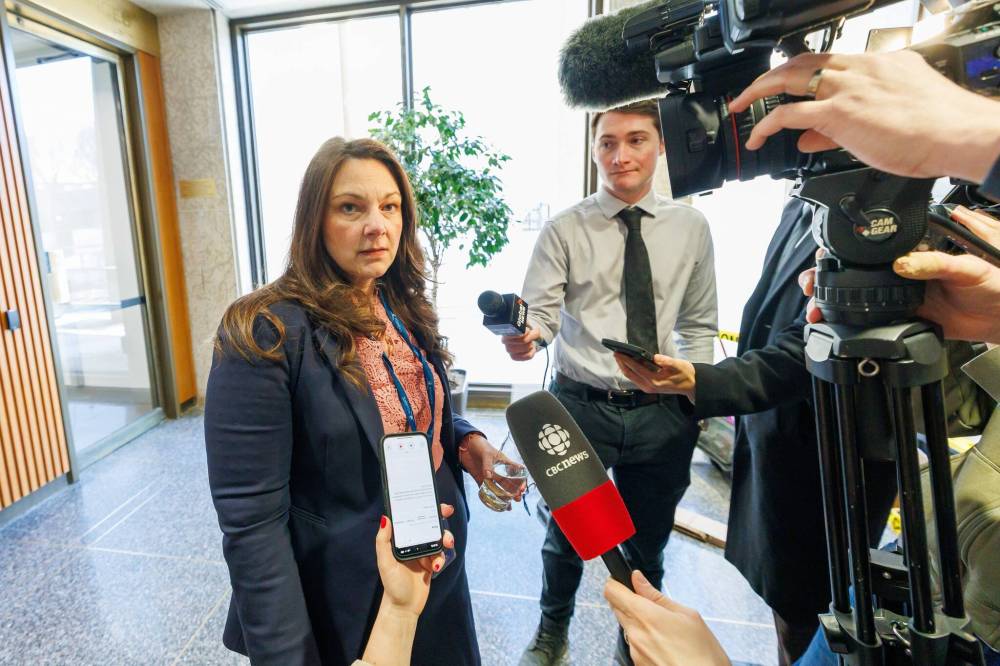
“Right now, we have de facto designated encampments. We have increasing social disorder that much of the sector is pointing toward our own policy and blaming it for causing the disruption to the whole entirety of the city and spreading the problem,” said Rollins (Fort Rouge-East Fort Garry).
The city’s policy includes a ban on camps near playgrounds, schools, daycares, adult care facilities, transit shelters and rail lines.
Rollins said the approach isn’t working.
“I believe Winnipeg absolutely is experiencing the lack of resourcing, outreach and public space maintenance, and the severity of the risks are increasing for Winnipeg, are increasing for private business and residents all over the city.”
Her plan, endorsed by Gilroy and Orlikow (River Heights-Fort Garry) would establish clear standards to maintain public spaces, including for garbage removal, sanitation and biohazard cleanup, accessibility, repairs, safety and restoration. It would create a framework to prioritize the response based on the scale, frequency, severity and persistence of the problem at individual sites.
It would also spell out which municipal departments and partner organizations are responsible for responding. The city would be required to measure whether its interventions restore public spaces over the long term, with reporting that distinguishes between temporary encampment clearances, relocations and sustained resolutions.
The city said it continues to remove garbage and debris from vacant and occupied encampments.
Crews cleaned 141 cleared or abandoned sites from November 2025 to June of this year. Some required days of work and heavy equipment because of large amounts of debris, hazardous material, difficult terrain or weather conditions.
The city also partnered with Siloam Mission in June and part of July to clean occupied encampments, where work must be done manually with no heavy equipment. The city reported that 25,111 pounds of garbage was collected.
The city said regular cleanups at occupied sites are needed to prevent garbage from accumulating and spreading to neighbouring properties, businesses and public spaces.
Rollins said the data is part of the problem.
“Those figures in isolation, whether it is the encampment cleared, and or the tonnage of garbage is meaningless if there is still a ton of garbage left on site, and there’s still a level of cleanliness that isn’t being done, and the so-called cleared encampment is just moved four metres over,” Rollins said. “The data isn’t telling the story, and it’s ringing false.”
Chris Brens, the city’s director of community development, who wrote the report that will be presented to the community service committee on Tuesday, was not made available Friday.
In an email, a city spokesperson said the public service is aware of the motion, but “we are not in a position to comment before the executive policy committee considers it and provides direction.”
Rollins said cities such as Edmonton, Vancouver, Ottawa, Calgary and Montreal have adopted approaches that combine cleanup and public-space maintenance with outreach, safety and social services.
Winnipeg, she said, falls short. Its system has no clear service standards, defined responsibilities, adequate resources or measurable outcomes that show whether public spaces have been restored long term.
“The lack of housing, shelter and addictions services cannot be used to excuse declining public-space maintenance,” Rollins said. “People experiencing homelessness also deserve a response that reduces risk, rather than allowing unsafe conditions to persist or simply moving impacts from one location to another.”
She said the city focuses too heavily on whether sites have been “cleared,” rather than whether associated problems such as garbage, sanitation hazards, fires and accessibility have been resolved.
Without regular services, the problems return and sometimes, the cost is paid by business groups and private property owners.

In July, the Free Press reported a landlord was threatened with having the cost of cleaning a nearby camp tacked onto his tax bill if he didn’t clean the area himself.
Last month, the city rescinded the order after learning an easement on the property made the city responsible for maintaining the area where the encampment is located.
Coun. Vivian Santos, who chairs the community services committee that will receive the latest encampment report on Tuesday, said Friday’s motion is a new version of a previous one.
“The city’s doing the best that they can with the money that they’ve gotten, and when you keep asking them to continue to do the reports, it just really becomes more bureaucratic and takes away from the work that they’re already doing.”
scott.billeck@freepress.mb.ca

Scott Billeck is a general assignment reporter for the Free Press. A Creative Communications graduate from Red River College, Scott has more than a decade’s worth of experience covering hockey, football and global pandemics. He joined the Free Press in 2024. Read more about Scott.
Every piece of reporting Scott produces is reviewed by an editing team before it is posted online or published in print — part of the Free Press‘s tradition, since 1872, of producing reliable independent journalism. Read more about Free Press’s history and mandate, and learn how our newsroom operates.
Our newsroom depends on a growing audience of readers to power our journalism. If you are not a paid reader, please consider becoming a subscriber.
Our newsroom depends on its audience of readers to power our journalism. Thank you for your support.